
#43: Thought Experiment: Don't Pay The Coordination Tax
Why do we need approval chains for low-value purchases?

Over the next several weeks, in these weekly editions, I’m going to challenge you on a series of organizational assumptions that feel sensible, responsible, and necessary - until you ask, “Will this survive if I am building the company today with what AI can now do?”
The wrong question is: “How do we “add AI” to what we do?” That gets you pilots, dashboards, and incremental improvements.
The right question is harder: “If AI makes something possible that wasn’t before, why are we still organized around the old constraint?” That’s the question that exposes structural rot.
Here’s the first one.
Your procurement team just spent 5 days and 3 sign-offs approving a $3K SaaS subscription. An AI agent could have enforced the same policy, verified budget, flagged the same risks, and maintained a better audit trail in under 30 seconds. So why didn’t it?
Because those approval layers aren’t there to make better decisions. They’re there so no single person takes the blame when something goes wrong. You’ve built a coordination tax disguised as governance. And it’s costing you more than you think.
So let’s start there. Questioning approval chains. Because if you can’t answer why yours still exists in its current form, you’re carrying organizational debt you can’t afford.
Not Ask: “How do we add AI to what we do?”
But Ask: “If AI makes X possible, why are we still organized around Y?”
Legacy Assumption
Multi-layer approval hierarchies exist to ensure oversight and accountability.
Finance signs off on budget.
Procurement checks vendor compliance.
The manager approves scope.
It feels thorough and responsible. It’s how you prevent bad decisions. Except it’s not. It’s how you prevent blame from landing on one person.
Most firms run procurement through 3-5 approval layers for anything above £2K. A line manager requests, their director approves, finance checks budget, procurement verifies the vendor, and maybe legal weighs in if it’s a new supplier.
The assumption: humans are needed to apply judgment, assess risk, and maintain control. Without those layers, you get maverick spend, compliance failures, and budget chaos. That assumption held when coordination was expensive -- when context lived in people’s heads, not systems, when audit trails were email threads you couldn’t trust and spreadsheets no one updated.
But that constraint is gone now with what AI can do inside the enterprise.
AI-Enabled Inversion
Auditable AI agents now enforce purchasing policy, flag anomalies, verify budget availability, and route exceptions in seconds with full traceability. They don’t skip steps, approve based on relationships, or go on holiday. What previously required human judgment now requires human-defined rules and real-time monitoring.
A 2025 procurement AI can auto-approve low-risk purchases under policy thresholds, surface high-risk outliers for human review, and maintain a tamper-proof audit trail that your old email approval chain never delivered.
Approveit reported in December 2025 that teams using AI-based risk scoring are hitting same-day approvals for 80% of low-risk purchase orders, down from 3-7 day cycles under manual routing. Fidelity Investments cut contracting time by 50% using AI-driven procurement workflows. The technology isn’t speculative. It’s in production.
Forcing Question
If you trust a line manager to approve £5K based on 30 seconds of email judgment, but won’t trust an AI agent with policy rails, risk scoring, and 24-hour audit logs, are you managing risk or managing the feeling of control?
Real Cost
Every approval cycle adds 3-7 days to procurement. Multiply by transaction volume and you’re bleeding velocity. Your competitors are closing deals, spinning up pilots, and moving faster not because they’re smarter, but because they’re not waiting for Steve in Finance to get back from his holiday to approve a $2K SaaS subscription.
The control you’re protecting catches almost nothing. A 2025 study found that:
teams with exception rates above 15% were still using manual approval routing;
those below 15% had implemented AI-based risk prompts that surfaced genuine outliers and auto-approved the rest.
You’re burning coordination budget on theatre. The speed you’re sacrificing compounds daily.And the catch: your approval layers don’t just slow you down, they cost you.
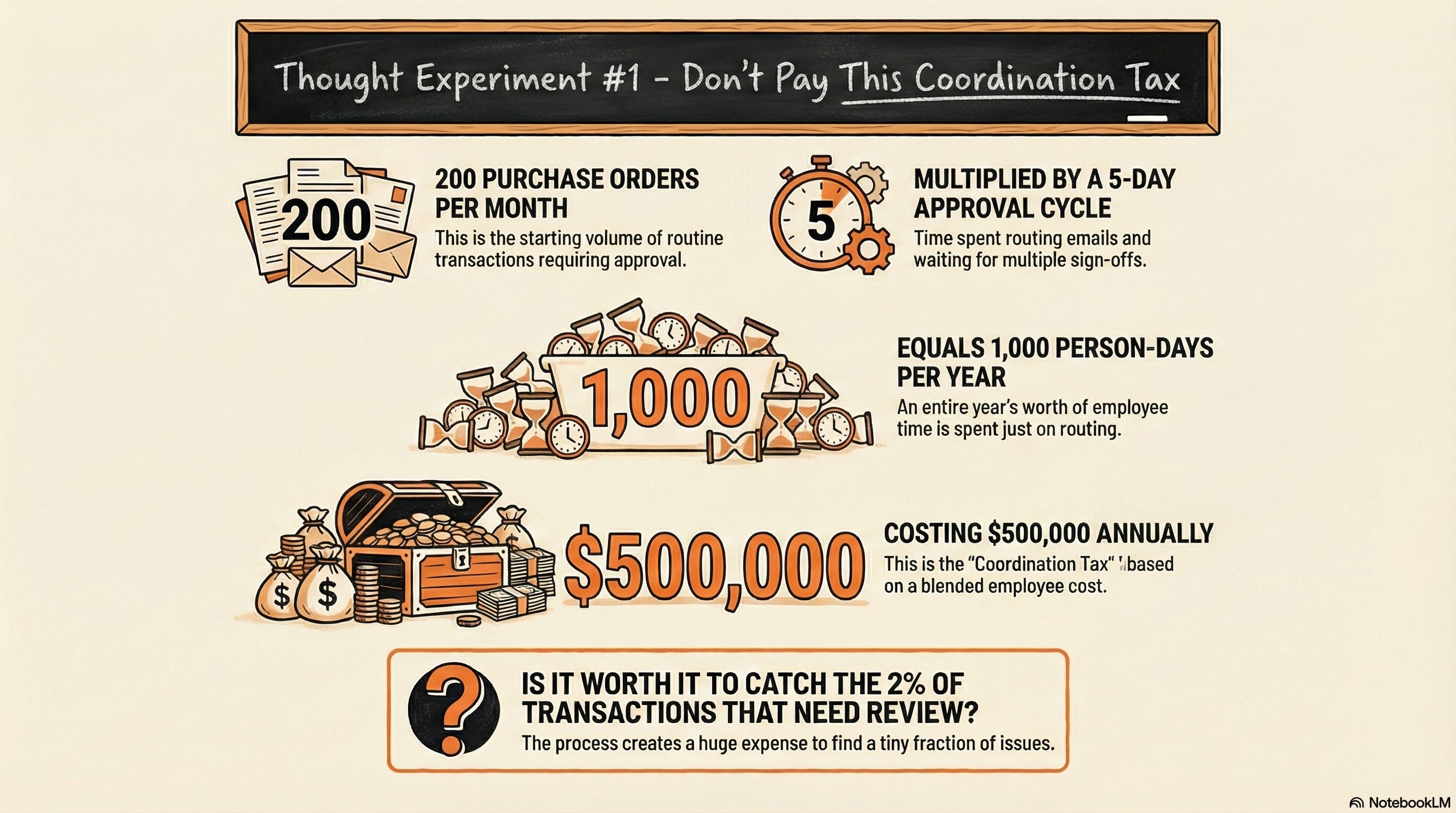
If you’re running 200 purchase orders a month through a 5-day approval cycle, that’s 1,000 person-days a year spent routing emails. At blended cost, that’s $500K in coordination tax. For what? To catch the 2% of transactions that actually need judgment?
Next Conversation
Do this:
Pull your last quarter’s sub-£5K purchase orders.
Scan 50 of them.
Count how many required genuine judgment versus basic policy checking.
That’s your automation opportunity and your current drag coefficient.
If 80% are pass/fail against rules you can encode, you’re paying human wages for work a policy engine handles faster, cheaper, and with better audit trails.
Then ask your finance team:
if we could auto-approve everything that fits policy and flag only the outliers, what would you do with the time back?
If the answer is “finally close the month on time” or “actually analyze spend patterns,” then congratulations, you’ve just found your business case.
If this scenario feels uncomfortably plausible, let’s talk. I and my team at Intelstack work with leaders at mid-size enterprises (200-1500 people) to map what AI makes possible and what it makes obsolete before your competition figures it out.