
Issue #16: The Retrieval-AI Shift: Win on Cost, Compliance, Career
How RAG is reshaping roles, creating new career opportunities, and driving strategic reskilling.

Straight Talk
I'm seeing Retrieval-Augmented Generation (RAG) move swiftly from experimental tech to strategic priority.
Nearly 4 of 5 enterprises running GenAI workloads are now using RAG on top of foundational models, fewer than 10% rely primarily on fine-tuning.
Why the sudden shift?
Cost Efficiency: RAG reduces costs dramatically, often delivering answers at less than 5% of fine-tuning's price.
Agility: Update your data in minutes, not weeks. No long GPU retraining cycles needed.
Security & Compliance: Frozen models ensure sensitive data stays safely behind your firewall, and answers always reference approved sources.
Fine-tuning still has its niche, especially for repetitive, structured tasks.
But for everyday queries, RAG clearly has the momentum. And this has important career implications.

The Simple Business Case
Here's how the math stacks up in practical terms:
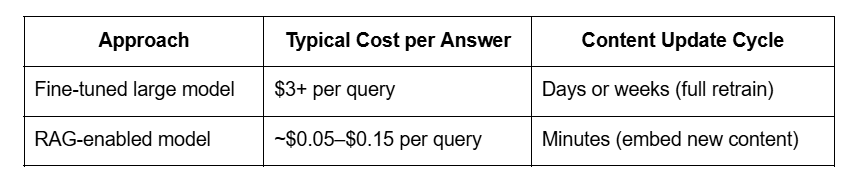
And this gap widens further as more efficient models enter the market.
Costs are illustrative and vary based on the specific foundation model, cloud provider, and query complexity.
Early Adopters Leading the Way
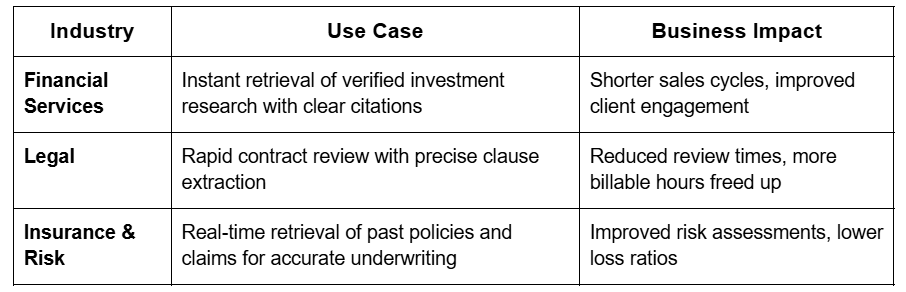
Common denominator seems to be faster answers, transparent sources, minimal cost, maximum compliance.
Implications for Jobs and Workflow
Sales & Service Teams: You will shift from information gathering to meaningful customer interactions, improving both productivity and customer experience.
Analysts & Associates: These roles will do strategic interpretation and advisory tasks, not manual data collecting and analysing.
Technology & Data Professionals: I expect to see growing demand for roles in data governance, retrieval engineering, and data-product management, rather than model maintenance.
Leadership & HR: HR folks should see moving away from advising business on downsizing to advising on strategic reskilling initiatives.
Career Snapshot - Skills, Salaries & Hiring Signals
Retrieval-aware Context (Prompt) engineering boom: Compensation now spans $95k–$270k, with bonus points for retrieval‑aware prompt design.
Vector/RAG keywords on fire: One‑third of new GenAI job postings explicitly call for vector‑database or RAG expertise.
Certifications racing to keep up: Microsoft’s updated Azure AI Engineer Associate (AI‑102) now tests RAG design skills, while AWS is adding a dedicated AI Practitioner – Retrieval badge by Feb 2025.
Interview focus areas: Expect deep dives on chunking strategies, hybrid vs sparse retrieval, and token‑cost control – evidence that employers want cost‑savvy builders.
Tool stack to know: Pinecone, Weaviate, pgvector, LangChain, LlamaIndex, Azure AI Search, Amazon Bedrock.
My Recommended Action Plan
Start with RAG: Reserve fine-tuning for cases clearly justified by ROI metrics.
Prioritize Data Quality: Retrieval accuracy directly depends on content freshness and relevance.
Demand Citations: No externally facing answers should go out without clear references.
Invest in Training: Equip your top talent with prompt-engineering and retrieval system management skills – these competencies are increasingly valuable.
Stay Agile: Maintain flexibility in your vendor agreements; technology will evolve rapidly, offering even better and cheaper solutions.
Bottom Line
RAG hits the sweet spot between cost reduction, compliance assurance, and business agility.
Fine-tuned models aren’t disappearing, but they're quickly becoming a specialized approach rather than the standard choice.
If you've encountered a scenario where fine-tuning still clearly outperforms RAG, let me know. I'll explore it further in upcoming editions.
-Srini